
Why can the removal truck not reach my door in Balgowlah Heights?
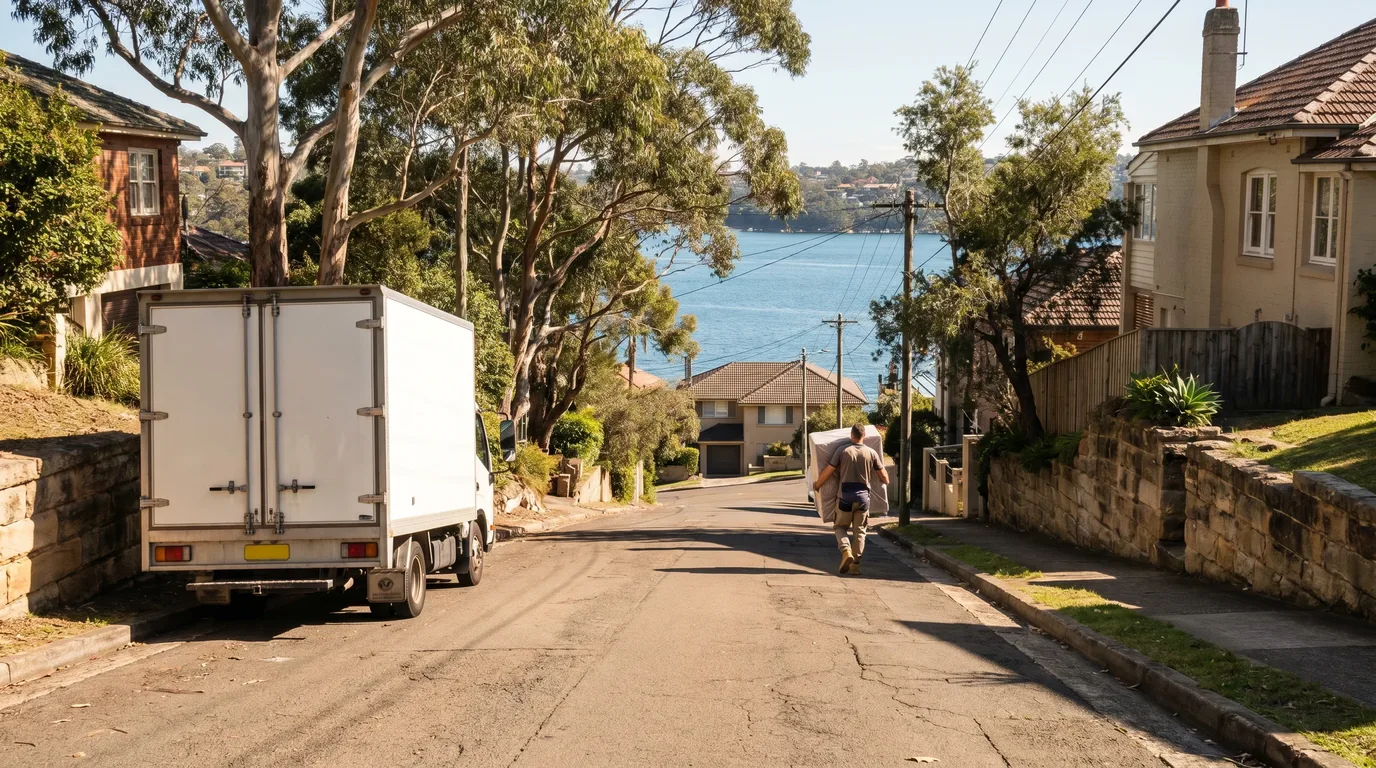
If you are moving to or from one of the harbour-side ridge suburbs of the Manly precinct, Balgowlah Heights, Seaforth or Clontarf, there is a good chance the removal truck will not pull up directly outside your front door. People often assume that is a problem with the removalist, or a parking rule, or bad luck on the day. It is none of those. It is the slope, and on the harbour side of this peninsula the slope is the single biggest thing that decides how a move runs.
The good news is that it is a completely solvable problem. The difference between a smooth move and a frustrating one is whether the gradient was planned for in advance or met as a surprise when the truck arrived. This post explains why the truck stages back, what a shuttle leg is, and the few things to tell your removalist so the slope never becomes the story of your move day.
The geography that sets the problem
Balgowlah Heights sits on a ridge that rises up to about 80 metres above North and Middle Harbour, with the streets on the harbour side dropping steeply toward the foreshore. The remnant Sydney Harbour bushland around Dobroyd Head and Grotto Point, and the foreshore beaches reached off the Manly Scenic Walkway, sit at the bottom of that fall. Seaforth perches above Middle Harbour at the Spit on the same kind of grade. Clontarf is a small foreshore suburb, 0.8 square kilometres on a sheltered inlet of Middle Harbour, where the streets run down to the water.
What these three share is the harbour-side block: a house that sits well above or below the road, on a steep, often narrow street, sometimes with a multi-level driveway and a view that was the whole reason someone bought the place. That view is paid for in gradient, and the gradient is what a removal crew has to plan around.
Why the truck stages back instead of pulling in
There are three honest reasons a full-size truck does not simply drive up to a steep door.
The first is room. A loaded pantech needs space to turn, level itself and open up the back. Many of the harbour-side streets here are narrow with tight kerbs near the water, and a steep driveway is often too short, too steep or too tight to take a truck of that size safely.
The second is safety on the grade. A heavy vehicle has to be able to hold itself still on a slope. Under the Heavy Vehicle (Vehicle Standards) National Regulation, a heavy vehicle parking brake must keep the vehicle stationary on a 12 per cent gradient on a dry, smooth road surface. Real harbour-side driveways are often steeper than that, and Sydney does not guarantee a dry surface. A driver who declines to take a loaded truck onto a wet, steep, tight approach is making the right call, not an excuse.
The third is your property. A truck reversing and turning on a tight slope near a sandstone retaining wall, a letterbox, a low-hanging branch or a neighbour’s car is a risk to things you would rather not have damaged. Staging the truck on flatter ground and carrying removes that risk entirely.
So the plan on a steep block is usually to stage the truck at the nearest wide, level point and carry the rest of the way, or to run a shuttle.
What a shuttle leg actually is
A shuttle is a smaller vehicle, a van or a small rigid truck, that ferries your belongings between the front door and the full-size truck parked on a wider, flatter street nearby. The big truck never has to attempt the steep approach; the small vehicle does the awkward last leg and the load is transferred where there is room to work safely.
This is standard practice for steep driveways and limited street access, not an unusual measure. The thing worth knowing is that a shuttle is an extra leg, so it can add to the time or the cost of a move. That is exactly why it is worth identifying before the day rather than discovering it when the truck cannot get up the drive. A move quoted with the shuttle already in the plan runs to time. A move that meets the slope as a surprise is the one that runs late.
A quick read on your own access
You do not need to be an expert to give a removalist the information that decides the plan. Before you ask for a quote, look at four things:
- Is the house above or below the road, or level with it? A house up a flight of steps or down a slope means a carry, not a roll-in.
- How steep and how long is the driveway, and how many turns? A short, steep or multi-level driveway usually means the truck stages on the street.
- How wide is the street, and can a truck turn? Narrow harbour-side streets with cars parked both sides limit what size truck can work.
- How many steps between the road and the door? This is the number that most changes the crew size and the time.
The flatter inland streets in all three suburbs are a more ordinary approach, so not every Balgowlah Heights or Seaforth move involves a slope problem. It is the foreshore-facing, view-side blocks where the gradient takes over.
What to tell your removalist
When you get a quote for a harbour-side ridge move, share the street address, whether the home sits above or below the road, the rough number of steps between road and door, and whether the street is wide enough for a truck. From that, a removalist who knows Balgowlah Heights, Seaforth and Clontarf can tell you the likely staging point, whether a shuttle leg is needed, and the right truck size and crew number for the grade. That five-minute conversation is the whole difference between a planned move and a surprised one.
The slope is not a reason to dread a move on the harbour side of the peninsula. It is simply the thing to plan around, the way the beachfront limits are in Manly and the village streets are in Freshwater. Plan for the gradient and it stops being the story of your day.
Get a quote for your Balgowlah Heights, Seaforth or Clontarf move and tell us about the slope. We will work out the staging, the carry and whether a shuttle leg is needed before you commit to a date.
Common questions
Why can a removal truck not park outside my house on a steep Balgowlah Heights street?
It is a safety and geometry problem, not a permit one. A loaded pantech on a steep, narrow harbour-side street has limited turning and staging room, and a heavy vehicle has to be able to hold itself stationary on the grade. Under the Heavy Vehicle (Vehicle Standards) National Regulation, a heavy vehicle parking brake must keep the vehicle stationary on a 12% gradient on a dry, smooth road. On a wet, steep, tight street the safe answer is often to stage the truck back on flatter ground.
What is a shuttle vehicle and will I be charged extra for one?
A shuttle is a smaller vehicle, a van or a small rigid truck, used to ferry your belongings between the front door and a full-size truck staged on a wider, flatter street nearby. It is a standard practice in the Sydney removals industry for tight or steep access. It can add to the time or cost of a move because it is an extra leg, so the honest thing is to identify whether you need one before the day, not discover it on it. Ask for it to be assessed when you get your quote.
Which Manly-precinct suburbs have the steepest access?
The harbour-side ridge suburbs: Balgowlah Heights (on a ridge up to about 80 metres above North and Middle Harbour), Seaforth (above Middle Harbour at the Spit), and Clontarf (foreshore streets dropping to Middle Harbour). The foreshore-facing streets toward Forty Baskets Beach, Grotto Point and the Manly Scenic Walkway are the steepest. The flatter inland streets in each suburb are a more straightforward approach.
Does a steep block mean my move will cost more?
Not automatically, but it can. A longer carry on a slope, or a shuttle leg, takes more time and sometimes more crew, and time is what most moves are priced on. The variable that actually controls the cost is how well the access is planned: the right truck size, the right crew number and a scouted staging point keep a steep move efficient. A move planned for the gradient runs to time; one that meets the slope as a surprise on the day is the one that blows out.
What should I tell my removalist about a steep or sloped property?
Share the street address, whether the driveway is steep or the house sits above or below the road, how many steps there are between the road and the door, and whether the street is wide enough for a truck to turn. From the address a removalist who knows the harbour-side ridges can usually tell you the likely staging point and whether a shuttle leg is needed. Get a quote and describe the slope and we will plan it.
Planning a move?
Get a free, no-obligation quote and we'll plan the access at both ends with you.
Get a quote